Everything homeowners need to know before hiring a scaffolding contractor in Passaic County
Types of Residential Scaffolding
Not all scaffolding is the same. The right system depends on your home’s height, the nature of the work, and how long the crew will need access. Here are the most common types used for residential projects in the Paterson area:
Supported Scaffolding
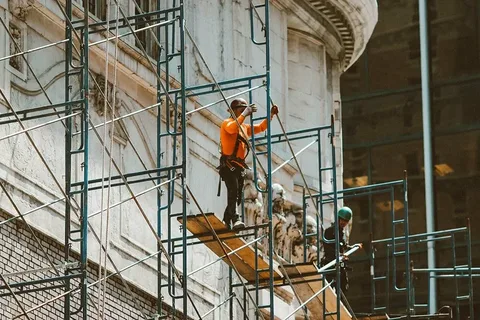
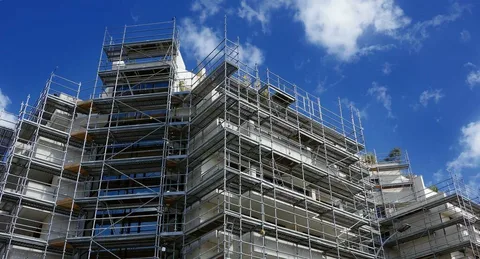
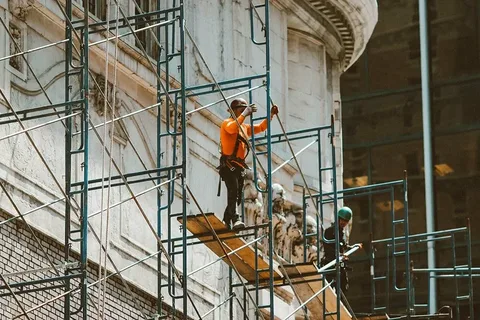
The most traditional option, supported scaffolding consists of platforms resting on poles or frames anchored to the ground. It’s ideal for multi-story row houses and detached homes where workers need stable, continuous access along an entire wall. This is the standard choice for masonry repairs and full exterior repaintings.
Suspended Scaffolding
In situations where ground anchoring is impractical — such as homes built close to a sidewalk or in tight urban lots common in Paterson’s South Side — suspended scaffolding hangs from roof-mounted rigs. This system is frequently used for facade cleaning and high-rise window replacements.
Rolling (Mobile) Scaffolding
Fitted with lockable casters, rolling scaffolding can be repositioned quickly without full disassembly. It suits single-story work or projects where the crew moves laterally across a structure, such as gutter replacement along a long ranch-style home.
Cantilever Scaffolding
Where ground conditions are uneven or obstructed — a common issue in Paterson neighborhoods with narrow side yards — cantilever systems project outward from a building anchor point, removing the need for ground-level support legs entirely.
“In a city as architecturally rich as Paterson, the right scaffolding system isn’t just about safety — it’s about protecting irreplaceable historic building fabric while the work gets done.”
Common Projects That Require Scaffolding
Paterson’s older housing stock means scaffolding is requested for a wide variety of residential tasks throughout the year. The most frequent include:
- Roof replacement and repair — especially slate, tile, and flat rubber roofing on older homes
- Chimney repointing and rebuilding — deteriorating mortar is extremely common in pre-1950 brick construction
- Full exterior painting on multi-story homes requiring even, stable access
- Facade restoration — including brick cleaning, tuckpointing, and brownstone repairs
- Window and door replacement on upper floors
- Siding installation, particularly fiber cement and vinyl on two- and three-family homes
- Gutter and fascia replacement on tall or steeply pitched structures
- Solar panel installation on homes with difficult roof access
If your project requires sustained work above 10 feet, a licensed scaffolding contractor will almost always be the safest and most cost-effective choice compared to improvised ladders or rental platforms operated by untrained workers.
Safety Standards & NJ Regulations
In New Jersey, residential scaffolding is governed by the New Jersey Department of Labor and Workforce Development, which largely mirrors OSHA’s 29 CFR Part 1926 Subpart Q standards for construction scaffolding. Key requirements include:
- Scaffolding must be capable of supporting at least four times its maximum intended load
- Guardrails are required on all open sides and ends of platforms more than 10 feet above the lower level
- All scaffolding must be erected, moved, and dismantled under the supervision of a qualified person
- Platforms must be fully planked or decked within the front-to-back dimension of the scaffold
- Access ladders or stair towers must be provided — workers may not climb cross-bracing
Reputable contractors in Paterson will be familiar with these requirements and will carry both general liability insurance and workers’ compensation coverage. Always ask to see certificates before work begins.
Pro Tip: Always Verify Insurance
Before any scaffolding goes up on your property, request a current certificate of insurance naming you as an additional insured. If a worker is injured on your property and the contractor lacks workers’ comp coverage, you could face significant legal liability.
This single step protects you more than any contract clause.
Permits in Paterson
The City of Paterson Construction Office requires a permit any time scaffolding will extend over a public sidewalk or roadway. This is relevant for the vast majority of row houses and attached multi-family homes in the city, where the front facade sits directly adjacent to a public walkway.
Your scaffolding contractor should handle the permitting process on your behalf, including coordinating with the Department of Public Works if a lane closure or partial sidewalk closure is needed. A responsible contractor will factor permit lead times — which can run one to two weeks in Paterson — into the project schedule so work isn’t delayed.
For projects entirely within private property lines (such as rear elevation work on a home with a deep setback), sidewalk permits may not be required, but always confirm with your contractor and the local office before assuming an exemption applies.
Cost Factors to Consider
Scaffolding costs in the Paterson and greater Passaic County area depend on several variables. Understanding them helps you evaluate quotes accurately and avoid surprises:
- Building height and linear footage — a three-story Victorian costs more to scaffold than a single-story ranch
- Rental duration — most contractors price per week; longer projects add up quickly
- Access complexity — tight side yards, sloped terrain, or proximity to overhead utilities increase labor cost
- System type — suspended scaffolding requires more specialized equipment and is typically priced higher than standard tube-and-clamp
- Permits and insurance — reputable contractors include these; be wary of unusually low bids that exclude them
- Mobilization fees — delivery, setup, and pickup of equipment are usually billed separately from daily or weekly rental rates
As a general benchmark, homeowners in the Paterson area can expect residential scaffolding to run between $800 and $3,500 for a standard single-family project, with complex multi-family or historic restoration jobs running higher. Always obtain at least three written quotes.
Choosing the Right Scaffolding Contractor
Not every company that offers scaffolding in northern New Jersey has the experience or compliance record appropriate for residential work in an older urban environment like Paterson. Here’s what to look for:
- Local experience — contractors familiar with Paterson’s tight lots, permit office, and building stock will anticipate complications that out-of-area operators miss
- NJ Home Improvement Contractor (HIC) registration — required by law for residential work in New Jersey
- Documented OSHA compliance — ask if crew supervisors hold an OSHA 10 or OSHA 30 card
- Verified reviews — look for contractors with reviews on Google, Angi, or the Better Business Bureau that specifically mention Paterson or Passaic County jobs
- Clear written contracts — a professional contractor will specify the scaffold type, platform square footage, rental period, permit responsibility, and insurance terms in writing
Word of mouth remains powerful in Paterson’s tight-knit neighborhoods. Ask neighbors who’ve recently completed exterior renovations which scaffolding company they used and whether they’d hire them again.
Final Thoughts
Paterson’s residential buildings are part of New Jersey’s architectural heritage, and maintaining them properly requires the right tools, the right safety systems, and the right professionals. Scaffolding is not a cost to minimize — it is the foundation on which quality exterior work gets done safely, efficiently, and to code.
Whether you’re repointing a century-old chimney on Eastside Park or refreshing the facade of a Victorian in the Bunker Hill neighborhood, a licensed, insured scaffolding contractor who knows the city is your most important hire. Do your homework, get multiple quotes, verify insurance, and don’t let a low bid from an unlicensed provider put your home — or someone else’s safety — at risk.